Watching Chroniques by Peeping Tom on November 15, 2005, at the Théâtre d’Antibes in Antibes, I once again reflected on how faithfully the company lives up to its name. “Peeping Tom” refers to a voyeur; and indeed, the company persistently peers into the social realm, producing unsettling, sharp, and dark works. Chroniques was no exception.
Peeping Tom’s strong position within the European dance scene since the early 2000s is not merely due to their fusion of dance and theatre, but to their use of a distinctly cinematic language. Rather than constructing linear narratives, Peeping Tom creates interconnected situations; dance virtuosity slips into acrobatics, while theatre transforms into an almost silent cinematic atmosphere.
In the Labyrinth of Time: Colonialism and Capitalism
As its title suggests, Chroniques places time at its center. Drawing from the root of the word chronology—chronos (time)—the work unfolds as a labyrinth of time. This labyrinth is structured around two axes: colonialism and capitalism. Time appears and disappears onstage like a cycle shaped by these two forces.
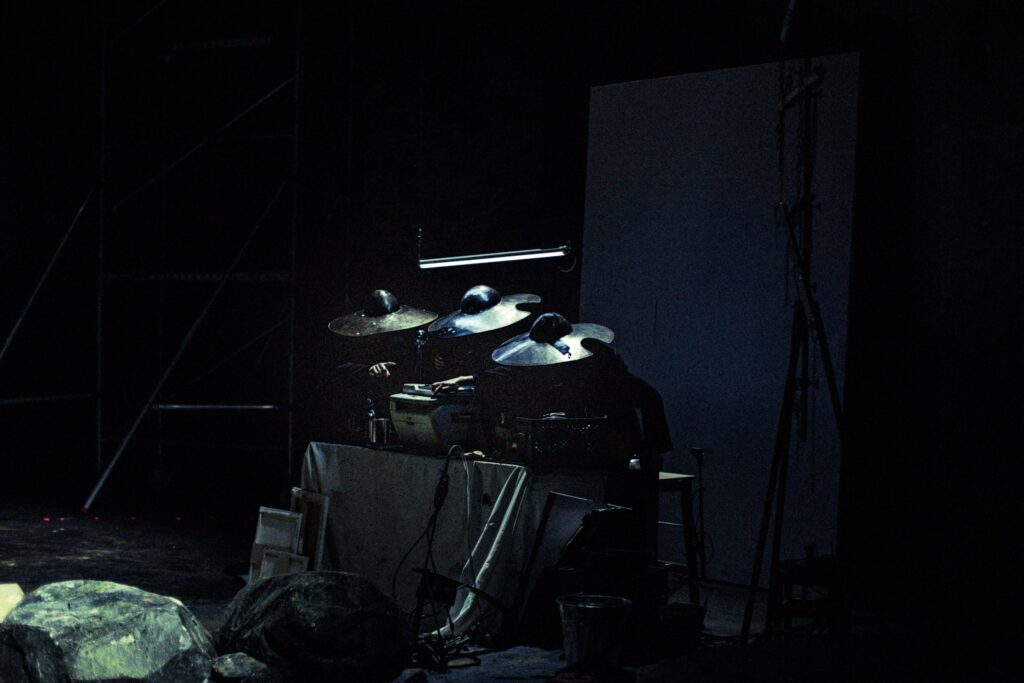
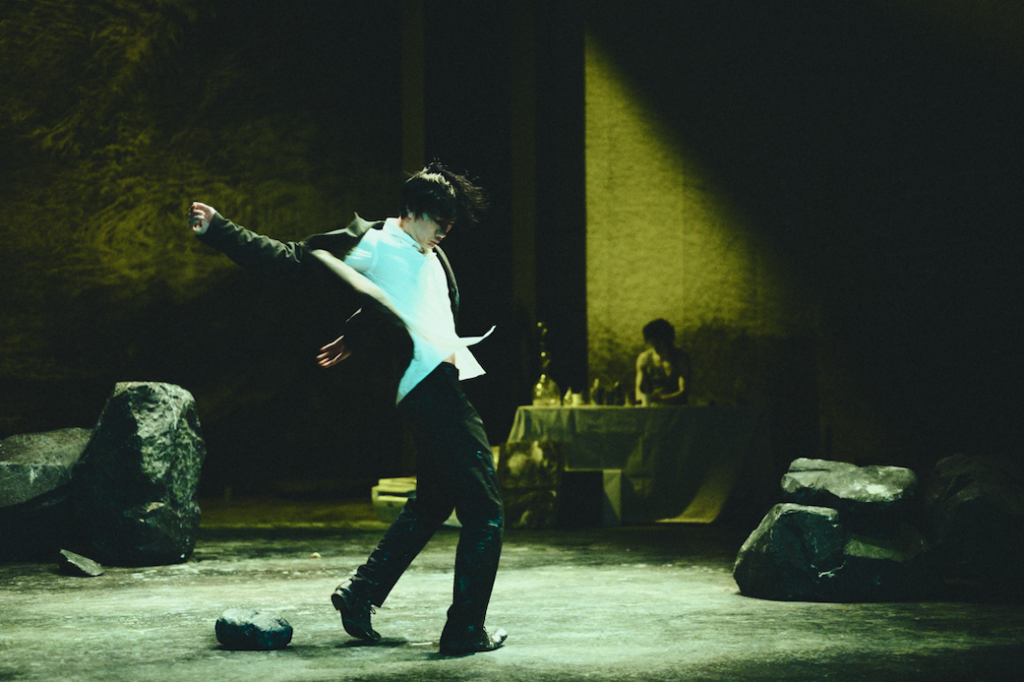
The set design by Amber Vandenhoeck features a few rock fragments, a massive canvas behind the back curtain, and an alchemical laboratory on stage right. The performance opens with the emergence of a sculptural body atop a rock—reminiscent of Myron’s Discobolus brought to life. Then, a box falls from above, fracturing time, and everything begins to unravel rapidly.
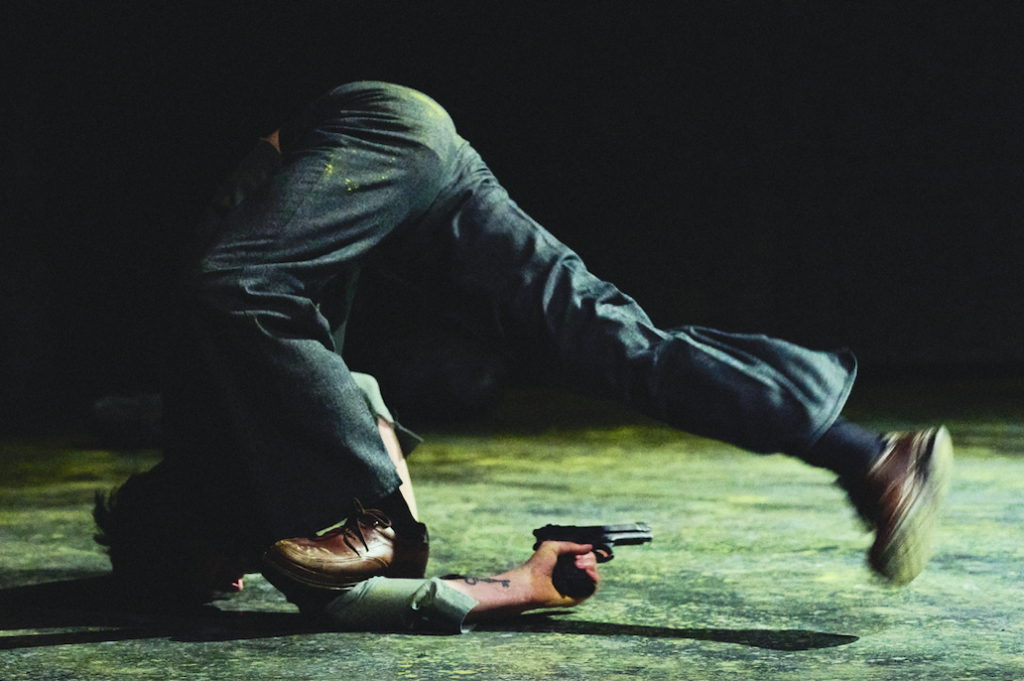
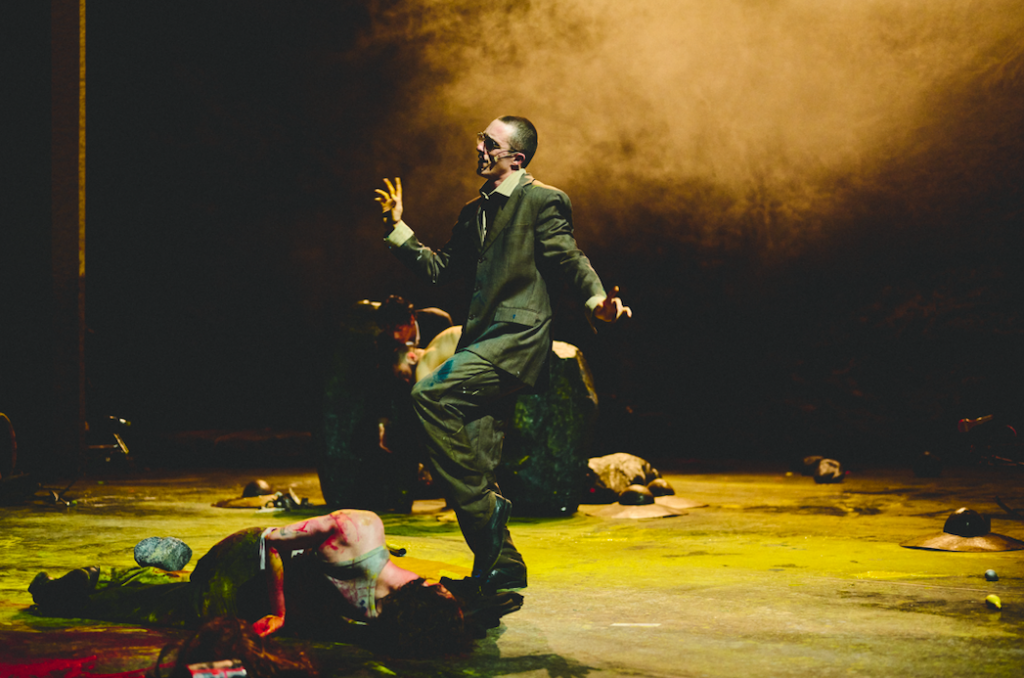
The performers—Simon Bus, Boston Gallacher, Balder Hansen, and Charlie Skuy—do not so much portray characters as embody symbolic bodies thrown out of different temporal moments. They reference a wide range of eras, from mythological archetypes to astronauts, from primitive humans to samurai, and even aesthetics associated with the Ku Klux Klan. Defining itself through situations rather than narrative, the piece progresses through stories that continuously interrupt the performative flow.
The Japanese Protagonist’s Conflict: By Whose Gaze Is the Body Interpreted?
Seungwoo Park occupies the center of the work as a “cultural foreigner,” a body that repeatedly attempts to establish agency yet fails each time. Questions regarding what the West expects from the Eastern body lingered in my mind: symbolic purity, or a framed, safe “Other”? Park transforms his body into a site of resistance against the Western fetishization of Eastern aesthetics.
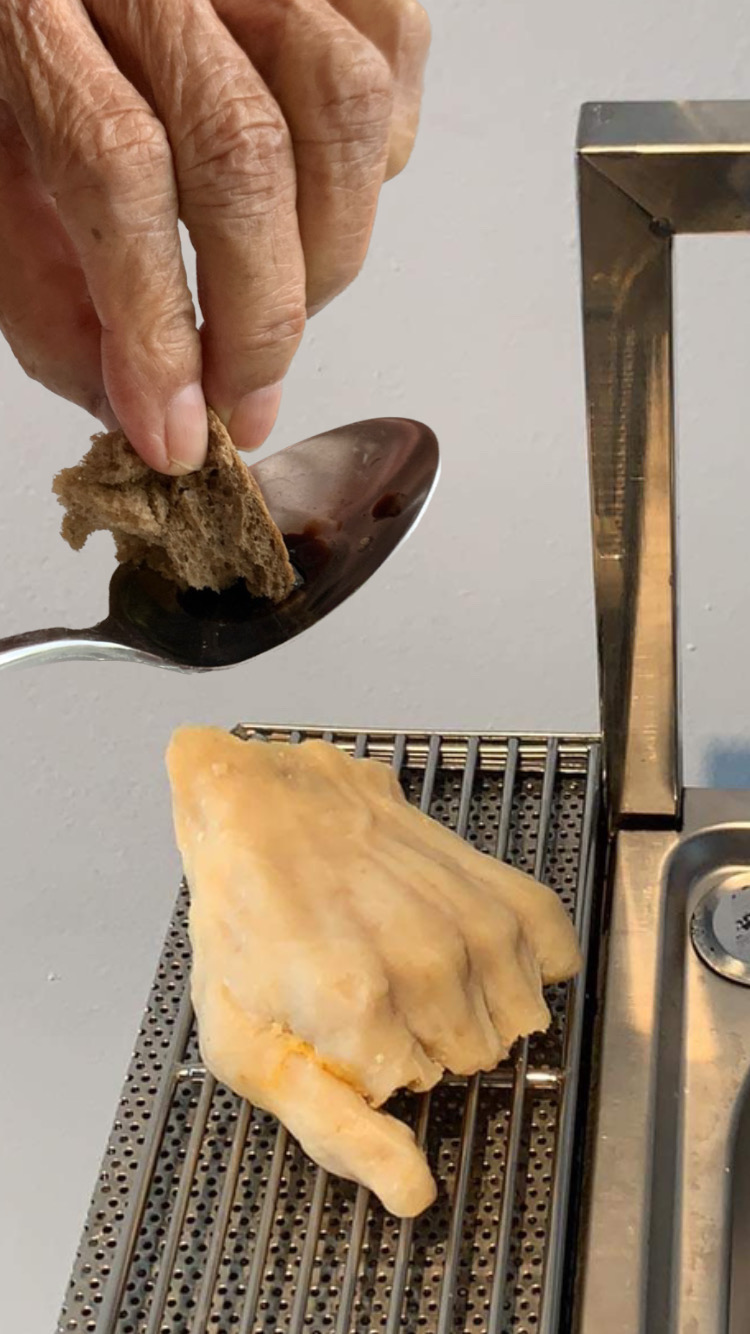
The scene that affected me most was the “severed hand” episode. The dancers played with the detached hand as if it were a surreal football, scattering it across the stage as an autonomous entity. Civilization’s point of origin was reduced to a toy. Park’s attempt to protect “his hand” gradually turned into a gesture of helplessness in the face of an increasingly de-identified world.
The Watching Canvas: The Dark Side of Enlightenment
At times, the back wall opens to reveal a painter working on a ladder. This figure resembles a surveilling authority, evoking a Big Brother is watching you-like presence that appears to direct the stage action. This Renaissance reference seems to gesture toward the darker side of the Enlightenment: the domination established through knowledge by a Eurocentric gaze.
This dark form of domination multiplies through war scenes. Blood is represented in rainbow colors; performers enact moments of being shot by hurling plastic bottles like hand grenades. This grotesque war, hinting at human-hunting tourism, is abruptly disrupted when two people enter the stage. Under harsh shower lighting, they begin to speak in a serious tone, as if reading a press release. One of them is shot. The fact that the victim is a woman, and that her body cannot be buried, renders the fragility of gender starkly visible.
In the final scene, a phone conversation unfolds between Seungwoo Park and another performer across water wells. Their exchange resembles a negotiation. While water symbolizes life, the well evokes the darkness of the unknown. As this sense of uncertainty repeats itself, mechanical, malfunctioning robots designed by Lolo & Sosaku enter the stage, transforming humanity’s broken rhythm into a metallic echo. The piece concludes with two limping, archaic robot sculptures moving to the song “I Can’t Stop Loving You.”
Chroniques is not merely a performance; it is a fractured X-ray in which the body becomes a fragmented object of political and cultural forces.
On the Company and the Production
Based in Belgium, Peeping Tom has secured a strong place in the European dance scene since its founding by Gabriela Carrizo and Franck Chartier. Their collaborations with institutions such as Nederlands Dans Theater, Göteborg Opera, Residenztheater, and Grand Théâtre de Genève have expanded the company’s aesthetic language. Chroniques was produced and co-produced by Théâtre National de Nice – CDN Nice Côte d’Azur. Peeping Tom benefits from extensive support networks; in Europe, not only municipal funding but also interconnected support from foundations and private institutions plays a crucial role.
Those curious about Peeping Tom should be prepared for +18 content: sexuality, abstract violence, loud sound, dense fog (an indispensable effect in their work), and strobe lighting are all part of the company’s signature aesthetic.