ART, TRADITION, and CREATIVITY
At one of the academic–student meetings1 I attended last April and May, I asked the students, “Is there anyone here who aims to become an artist?” There were about a hundred conservatory students or graduates in the hall, and only one person raised his hand. I was very surprised, because one of the fundamental goals of the education we offer in conservatories is precisely to train artists. This scene stayed with me for a long time, and I began thinking about the reasons behind it. I also shared this situation with my students in my classes. This writing, which brings together my experiences, questions, and readings, is a kind of essay—perhaps it will offer a ground on which ideas can be shared, questions multiplied, and collective thinking continued…
In Search of Possible Answers…
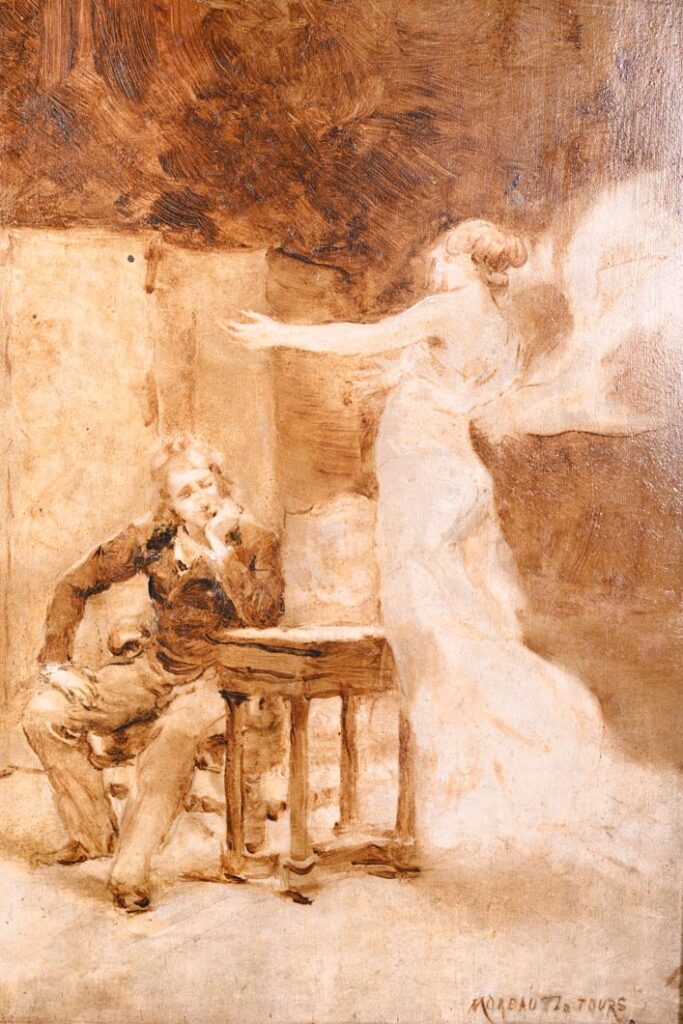
The possible answers to my question were related to what exactly is understood by the term “artist.” Despite all the efforts to change the image of the artist and bring art into contact with life, the dominant image remained unchanged: a figure endowed with a special talent, thus different from—indeed, even “superior” to—“ordinary” people; a bohemian genius chasing after a “muse.” (And since the words genius and muse are on the table, it becomes obvious what gender the dominant artist image belongs to—but that’s not our topic here :)
Unless educators discuss the concept of art in classes through a historical and critical perspective, students—most of whom do not engage in additional reading on their own—probably do not see themselves in the position of “genius.” For many students who take the conservatories’ special “talent” exams, the main expectation is securing a music-teaching position that would allow them to put bread on the table—though even that has now become a distant dream. The other opportunities that appear before them after graduation do not offer much room for imagining anything different either. If they wish, perhaps they can “make art” in the time left after work, if they manage to find the time, before getting swept into family responsibilities—why not?
There is another factor restricting the imaginative horizons of students enrolled in Turkish Folk Dance departments in conservatories: the folk-dancing environment they are born into. The evaluation criteria of the folk dance competitions they participate in from childhood not only shape their styles of staging but also format their thoughts, dreams, and imaginations. In folk dance associations, they are trained to perform in accordance with the criteria of the “stylized” or “authentic” competition categories. They are lined up by their instructors according to height and gender—from tallest to shortest, one girl one boy—wearing identical costumes. The whole “team” repeats the same movements and patterns, maintains straight lines, avoids “blocking” one another, definitely does not drop their handkerchiefs (a reason for point deduction!), and dance while smiling as much as possible to appeal to the jury. The implicit assumption behind this anonymous image they create is the claim of “representing” a city, region, or culture and preserving it through “correct” representation. Even when they know nothing about that culture, have never breathed the air or water of that region, the task remains monumental! This is why the founders of this field invented terms such as “stage arrangement” instead of “choreography”—their premise being to “present” the “authentic” dances and steps created by the people through various geometric shapes/patterns without intervening in them…
The representational function assigned to this widespread practice—which I would describe as mainstream folk-dancing—keeps dancers far away from concepts such as creativity, experimentation, and artistic production, and even from thinking about them. We must also remember that the historical, geographical, and cultural meanings of the terms art, play, and dance vary greatly. The academic literature that constitutes art theory is largely shaped by Western authors and consists of art-historical narratives and theories focused on painting, sculpture, and architecture. In the field of dance, the established definitions are again produced by academics trained in Western countries, focusing on the theatrical dance forms such as ballet, modern dance, dance theater, and contemporary dance that emerged in Western Europe and North America. Yet the definitions used in academia and the art world have little validity in everyday life. For example, in the “halay region” where I myself have been living for the last two years, different dance traditions (such as tango, salsa, or breakdance), which fall outside the problematic local categorizations (zeybek, karşılama, horon, bar, etc.), are lumped together under the label “modern dance,” meaning “styles foreign to this geography.” Students may call a flamenco or waltz performance they have never seen before “modern dance.”
Moreover, defining a performance practice that falls outside the dominant competition format of “Turkish folk dances” becomes almost impossible. For instance, we hesitate to call a piece as “folk dance choreography” if it is based on dancers’ natural, everyday ways of dancing; uses everyday clothing; allows performers to have a presence on stage as themselves rather than as anonymous representatives of regional dances; and focuses on their communication with each other and their movement out of “real” emotions. Staging a dance tradition in its naturally transformed form can in fact be a contemporary approach, but is it possible to call such a piece a contemporary dance choreography? Similarly, will we call choreographies that are based on traditional forms but combine them with new movements emerging through improvisation “contemporary dance”? Contemporary dance is a genre with its own historicity, containing a diversity of techniques, styles, and approaches—and in my view, all dances are sisters :) —yet those trained particularly in this field need to know the differences and rethink the definitions accordingly.
What Would I Have Answered at Their Age?
Returning to the question I asked at the very beginning, I took a nostalgic journey when I wondered what answer I would have given at the age of the students in that hall. I too started “folk dancing” in primary school, but unlike the students in the room, I did not study in a conservatory. Although my dance practice has been continuous, I completed my undergraduate and graduate studies in different fields. Like many young people living in this geography, the effort to carve out my own path came at the cost of extraordinary labor. In the process of turning my experiences as a performer, instructor, choreographer, translator, researcher, dramaturg, etc. into a profession, the struggle to explain myself (or my inability to explain myself) exhausted me. I have always had difficulty describing my work both to “insiders” and “outsiders” in the field. Even though various facets of dance art have been at the center of my life, I too have often refrained from positioning myself as an “artist.” Even when I said “I am a dancer,” I felt compelled to add footnotes that stretched into paragraphs. To ensure that the concepts I used meant something in my listener’s mind, I had to explain them in their own language. Throughout my life, I have been tested by having to give calm answers to questions from faculty administrators or jury members during academic evaluations—questions along the lines of: “Dance, history, politics—how are these related? Are you confused?” Over time, layers of shells form on your body, but the exams of academic life never end, even if you have professorial stripes; they simply change shape and multiply according to the spirit of the time and place…
At the point I have reached today, I can say that I have wholeheartedly embraced the earlier generations’ insistence on not separating art from life. I do not separate my academic and artistic work either; I adopt a self-reflexive perspective in my teaching, writing, and artistic production processes, and I continuously question my own position.2 I fulfill some artistic practices that value the process as much as the result; and I strive to make the stages of education, rehearsal, and performance as transparent, inclusive, experimental, and participatory as possible.
To cultivate a critical perspective in art education, I believe we must first reflect on how the concepts of “art” and “artist” have emerged and changed throughout history. Thinking about how experimental and avant-garde productions—those that challenge established power relations, refuse to settle for the mainstream, and seek alternatives—have transformed our understanding of art will open new doors for us. With this objective, I will refer to one of the key works in art history and art theory literature, which largely focuses on visual art forms such as painting, sculpture, and architecture. Drawing on Larry Shiner’s The Invention of Art: A Cultural History (2001), I will first offer a historicization of the concept of art and then focus on the possibilities of thinking tradition and creativity together.
Art
In his book, which centers on visual arts, literature, and music, Shiner discusses the concepts of the art category, the artist ideal, and the aesthetic experience. He states that during the period between approximately 1350 and 1600—commonly known as the Renaissance—a long and gradual transition from the old art-craft system to the modern fine arts system began (2004: 74). He argues that the emergence of the artist biography, the development of the self-portrait, and the rise of the court artist serve as three indicators pointing to the birth of the modern concept of the artist (2004: 80). In the newly emerging absolutist monarchies, painting, poetry, and music gained increasing importance, and the status of artisan/artists steadily rose (2004: 103).
The modern fine arts system took shape over a period of roughly 150 years through three phases:
1) 1680–1750: The gradual integration of various elements of the modern art system that had been emerging in fragmented form since the late Middle Ages;
2) 1750–1800: The definitive separation of fine arts from craft, the artist from the artisan, and aesthetics from other modes of experience;
3) 1800–1830: The phase of consolidation and elevation: the term art begins to denote an autonomous spiritual domain; the artistic vocation is sanctified; the concept of aesthetics starts to replace taste (2004: 133–134).
Within this three-phase process, artistic ideals and institutions underwent major transformations in Europe. The 17th-century world—where art was consciously integrated into society and where only a few artistic institutions existed—gave way to a world shaped largely by the newly rising middle class and its developing arts market system. Institutions and practices of modern fine arts slowly emerged.
In the field of painting, exhibitions, auctions, art dealers, art criticism, art history, and the emphasis on the artist’s signature came to the foreground. In music, secular concerts, music criticism, and music history appeared. Opera, once followed mostly by the aristocracy, began to lose its popularity. The concepts of the work, opus numbers, complete notation, and finished compositions emerged. Practices such as borrowing material from other musicians or reusing one’s own works gradually disappeared (2004: 239–240), and in 1709 the first copyright law was enacted in England (2004: 176).
In literature, lending libraries, literary criticism, and literary history emerged. Vernacular language canons began to develop. With the application of copyright laws, the writer gained a new status as a free and creative subject (2004: 240).
Before the French Revolution, most artists were employed by churches, royal families, aristocratic patrons, or a few theaters. As a larger—though unstable—market emerged in which they could sell their services, the patronage system began to collapse (2004: 262). Over time, commissions decreased; writers, musicians, and painters were forced to sell their work in an increasingly precarious market. During this process, the emphasis on the ideal of the “genius” and the “free art” of the genius grew steadily stronger (2004: 264).
The term fine arts (beaux-arts in French, fine arts in English) became established in the late 18th century, yet the list of arts it referred to varied from one writer to another. Poetry, painting, sculpture, music, and architecture formed the most widely accepted core, though some thinkers added further arts to this cluster: dance (Batteux; Moses Mendelssohn), oratory (J. A. Schlegel; Thomas Robertson), engraving (Jacques Lacombe; Jean-François Marmontel), and landscape gardening (Henry Home, Lord Kames; Immanuel Kant) (2004: 146).
Immediately following these transformations, from roughly 1830 to 1930, various art forms experienced waves of questioning, experimentation, and stylistic fragmentation. Representational modes in painting with Picasso, traditional narrative techniques in the novel with Woolf, the standard tonal system in music with Schoenberg, classical balletic movements in the dance with Duncan, and traditional architectural forms with Le Corbusier all began to lose their centrality (2004: 369). Multidimensional perspectives, abstraction, atonality, and similar concepts underlying modernist experimentation replaced the earlier art/craft ideals of representation, imitation, beauty, and function. The ideal of the creative vision emerged. Calling a work meaningful, complex, or challenging became a greater compliment than calling it beautiful (2004: 370).
In 1917, Marcel Duchamp’s presentation of a urinal—turned upside down—as an artwork became one of the major symbols of modernism in art history. The artist did not create a new work in the traditional sense; instead, he designated a “readymade.” By freeing the urinal from its functional context and redefining it within an aesthetic one, the artwork became the act of “context shift” itself. “In other words, the idea was a beautiful thing! The idea itself was art!” (Dellaloğlu, 2020: 267–268).
Dance has never been among the art forms placed at the center of the historical narrative summarized above. The histories of dance, music, and theater would not be incorporated into the field of “art history”; instead, each would emerge as a separate body of writing—dance history, music history, theater history. Within dance history narratives as well, the stage dance forms of North America and Western Europe (ballet, modern dance, contemporary dance) occupy the central position.
Tradition and Creativity
Historically, the core of stage dance and choreography has been the skillful ability to move bodies. Because “live” arts such as theater and dance—and their performers—rely on bodily labor, they have often been considered marginal within the arts. Today, artists who create movement-based work, much like artists in other fields, reflect on the very medium at the center of their production: the body. Alongside bodily labor—or precisely by questioning it—they also pursue conceptual production. Dance researchers, including myself, who draw on critical theories, contribute writings that evaluate such alternative choreographies and leave notes for the future—notes that may one day be included in more inclusive dance history narratives.
So how do ideas and creativity meet artistic productions based on local dance traditions? And who looks for such a meeting, why, and how is it realized? My colleague Andriy Nahachewsky (2008), whose work has always inspired me, offers important clues in one of his articles. Drawing on years of observation of dance groups and individuals in Canada and elsewhere—particularly those aiming to revitalize folk dance—he categorizes their main motivations and priorities into four and a half :) types:
1)enjoyers,
2)preservers,
3)presenters,
4)creators, and
4.5) all-stars, those who do a little bit of everything.
Nahachewsky explains that these different strategies shape the structures, activities, and staging practices of dance communities. He notes that, in each category, the communication between three groups involved in folk dance activities changes: people in the source culture, the performers themselves, and the receiving culture (the spectators). For example, enjoyers focus on their own experience; they have no priority of presenting something to an audience or preserving a particular culture. Most preservers feel they belong to a specific culture, and their main motivation is to identify the oldest, most traditional, most “authentic” forms within the source culture and transmit on to new generations. Presenters, by contrast, aim to showcase the dances of a culture they feel connected to; dance becomes a tool to promote their culture. They believe they have the right to improvise and be creative within the boundaries of tradition. Creators see themselves as artists within the receiving culture, and their primary motivation is to create dance within this cultural sphere. They may select sources of inspiration from multiple source cultures and adapt raw folk dance material to new cultural contexts.
These categories are neither fixed nor singular; many individuals or communities may blend more than one in practice. Those in the all-stars category may feel like a dream team made of all-star players: claiming they reflect the source culture, are creative, and reach contemporary audiences at the same time. Yet those who believe they can do everything risk mastering nothing. Nahachewsky emphasizes that none of these categories is inherently superior to the others. When evaluating all-stars, he compares them to the wide range of vehicles we might buy for different purposes—sports cars, family minivans, pickup trucks and notes that seeking a single vehicle that can do everything is neither realistic nor economical. Likewise, those who lead folk dance communities must decide what the true strategy is, for resources are always limited, and conflicting strategies often lead groups down unproductive paths. Dance groups driven by the assumption that “authenticity is good”—an assumption that pulls them into conservative waters—are like expensive hybrid vehicles claiming to combine a sports car, a family minivan, and a pickup truck, yet in reality being good at none and consuming a great deal of fuel (2008: 49–50).
When I bring together the strategies described by Nahachewsky with my own practices, I find myself closest to the creators category. For someone who does not feel belonging to a single culture, who encountered diverse dance traditions in her hometown of Istanbul, and who grew up in independent art circles, adopting a “preserver” strategy seems unlikely. I have continually sought and redefined my artistic priorities. Today, it seems fair to say that conservatory students who distance themselves from the notion of being an “artist” also do not feel close to this category. Many may see themselves as carriers, transmitters, or representatives of a particular musical or dance tradition. In other words, they assume the mission of identifying the most traditional forms of a source culture and transmitting them to new generations in the most “correct” way, thereby ensuring their survival. Yet they may overlook the fact that the traditions they “represent,” like art itself, constantly shift according to contemporary social, economic, political, and other needs—and are even continually reinvented. Thus, debates on what is most traditional, most “correct,” or what counts as “distorted,” “corrupted,” or “wrong” often lack solid grounding.
When making judgments in reference to tradition, it is crucial to remember that it contains both continuity and change. In the “tradition” entry of the Encyclopedia of Cultural Studies, cultural sociologist Besim F. Dellaloğlu writes that for something to remain a tradition, it must also be “modern,” that is, it must exist in the present (2020: 271). Citing T. S. Eliot, he argues that great works emerge when art contains both tradition and creativity. Reflecting on his experiences at the Faculty of Arts, Design, and Architecture before retirement, he provides a critical perspective by examining the arts from the “outside.” The modernist mentalities dominant in our society cannot imagine that tradition and individual talent can coexist. In this mindset, traditional arts and modern arts—believed to enable creativity—are kept separate. Yet just as calligraphy and tilework are traditional, painting and ceramics are equally traditional; however, because painting and ceramics are perceived as Western forms, they are assumed to be inherently modern and therefore not traditional. Similarly, calligraphy and tile art are assumed to be inherently non-modern because they are not Western; hence, they are believed to be only traditional. At many Fine Arts faculties in Turkey, those confined to the “traditional” label—the ones believed to be closed to creativity—are exclusively the “Turkish arts” (2020: 268).
If we rethink such assumptions—which dominate visual arts education—through the lens of music and dance, can we truly say that the situation is different? Contemporary dance and Turkish folk dance, or the flute and the bağlama, are considered distant from each other. According to the dominant view, in “Westernizing” state conservatories where ballet, modern dance, viola, piano, etc. are taught, a “modern” education is offered—supposedly more open to individual creativity. But in state conservatories of Turkish Music (or “Turkish Art Music”), where Turkish folk dance, bağlama, davul, etc. are taught, are we offering a traditional (i.e., “Eastern”? and creativity-proof?) education? If we limit the question to dance: When will we break away from the assumptions that define contemporary dance by referring to the geography in which it first emerged (“the West”) and position it as a field of individual creativity, while confining “Turkish Folk Dance” to a framework of cultural representation? When will we move beyond protectionism that lacks the necessary intellectual and artistic endeavour to access knowledge about what we define as tradition—and thereby begin to think tradition together with creativity?
Let me end with a reference from the same book, perhaps opening another door for us to think together. The 19th-century literary critic Sainte-Beuve wrote that tradition must be continually examined from the closest points to the present, even rejuvenated, and kept in constant contact with life. He warned us: “The greatest danger is to fall asleep within tradition” (2020: 267).
REFERENCES
Dellaloğlu, Besim F. 2020. Poetic and Political – An Encyclopedia of Cultural Studies. Istanbul: Timaş Yayınları.
Nahachewsky, Andriy. 2008. “Folk Dance Revival Strategies.” Ethnologies 30 (1): 41–57. https://doi.org/10.7202/018834ar
Shiner, Larry. 2004 (original 2001). The Invention of Art: A Cultural History, trans. İsmail Türkmen. Istanbul: Ayrıntı Yayınları, p. 408, Art and Theory Series: 7, 1st edition.
Image 1.
Georges Moreau de Tours, The Painter and His Muse
https://www.marcmaison.com/objets-d-art-19th-century-paintings-and-furniture/tableaux/georges-moreau-de-tours-%E2%80%93-the-painter-and-his-muse-signed-grisaille-painting
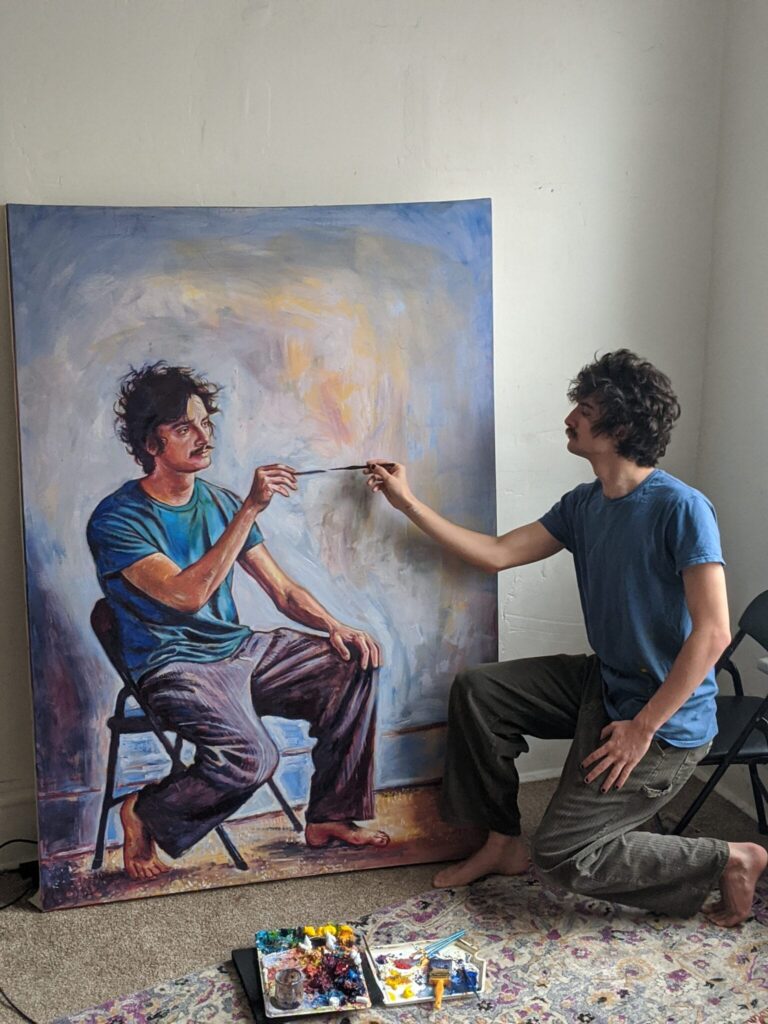
Image 2.
Seamus Wray, (self)-portraying himself while painting
https://www.thisiscolossal.com/2020/07/seamus-wray-self-portraits/
1 On 25–26 April 2025, Dicle University’s Department of Turkish Folk Dance organized the 2nd Academic Folk Dance Workshop. The workshop featured sessions titled “Analysis and Systematic Classification in Traditional Dances” and “The Relationship Between the Dance Profession and Traditional Dance Education.” On 21 May 2025, the “Folk Dances Gathering in Ardahan”, the workshop and master class event, held at Ardahan University, also brought together many academics and students. The gathering addressed topics such as the academic challenges faced by undergraduate programs in Turkish Folk Dance and efforts to include folk dance as a course in pre-university education, among others. Guest instructors conducted short workshops with the students.
2 After the professional gatherings in April and May, I began reassessing my own work based on the issues and needs of the field. Around the same time, cases of harassment and abuse came to the fore—first through disclosures in the arts and then spreading to other sectors. This process reminded me how urgently we need transparent, safe, creativity-driven, and critically oriented pedagogical approaches within educational institutions. As art educators, we must think carefully about how we act, how we communicate, and what we make room for. I believe that an educator who does not reflect on his/her own position and who does not aim to open new doors for those they teach has no real function in the era we are living in. We impact the lives of people who are just at the beginning of their artistic paths, who have not yet had the chance to develop their own approach; whether we pursue it or not, we become a kind of “role model.” As the disclosed cases of harassment and abuse demonstrate, the ways we establish contact—both tangible and intangible—leave serious marks. Avoiding structures that render boundary violations invisible, and creating safe environments that open pathways to creativity and critical thinking, is a responsibility we all share.